The evolution of OPRC 2 training
OPRC Level 2 training has supported oil spill preparedness for decades and has been widely known as IMO Level 2, reflecting its alignment with the IMO Model Course. While the accreditation framework has remained largely unchanged, the way the course is delivered has evolved to reflect modern learning environments and delegate expectations.
As one of OSRL’s most experienced principal trainers notes:
The course content guidelines for accreditation have changed very little… but the delivery of this content definitely has.
From static delivery to interactive learning
Early courses relied on static presentation methods and limited technology. Today, the focus is firmly on interaction, discussion, and participation, ensuring all delegates can contribute.
The delivery style now is very much more interactive and caters for all delegates.
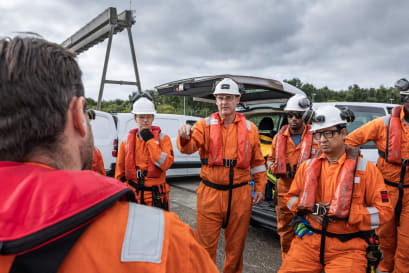
In the UK and Singapore, the course also developed a reputation for its three practical deployment exercises, delivered alongside the classroom programme. This format became commonly referred to by delegates as the ‘clearance course’, reflecting both its intensity and its role in confirming operational readiness.
While highly valued, this approach also required a significant time commitment, particularly for delegates travelling internationally.
Responding to delegate feedback on time commitment
Feedback has consistently highlighted the challenge of committing to a five-day course, particularly where travel is required.
It’s a big commitment to attend a 5-day course, often overseas.
OSRL refined the course structure and content to focus on high-value learning activities and delegate availability, ensuring the time delegates spend away from their operational roles delivers maximum benefit. The updated OPRC 2 format remains fully aligned with OPRC Level 2 (IMO Model Course) requirements.
Course delivery options and flexibility
OPRC 2 training can be delivered in several formats to suit operational needs. OSRL offers published courses at selected global locations, customised training aligned to local arrangements and operating contexts, and the ability to run courses in additional locations where demand exists.
Delivery can be adapted to suit facilities, operating environments, and delegate availability, while remaining fully aligned to OPRC Level 2, based on the IMO Model Course requirements.
A shared foundation with the Responder Training Programme
For OSRL trainers and responders, OPRC 2 is not taught in isolation. Many instructors first encountered IMO Level 2 as part of OSRL’s internal Responder Training (Offline) programme — a route that remains foundational to how training is designed and delivered today.
The first iteration of this internal training was delivered in 2007, and it has been continuously refined since. Commonly referred to as offline training, the programme is a 12-week course combining classroom learning, practical activity, and ongoing assessment to develop new recruits into competent oil spill responders.
Responder Training (Offline) is unique within the industry. It is built around the understanding that people are OSRL’s greatest asset, and that technical capability must be matched by behavioural competence and confidence to mobilise.
The programme is structured around clear outcomes:
- Developing the knowledge and skills required to safely and effectively perform the role of an oil spill responder
- Building the confidence and judgement needed to mobilise on real responses
Progress is measured against OSRL’s OPITO-approved Competence Management System (ACMS), using continual assessment and formal evaluation during course end exercises. The guiding question is deliberately practical: would we mobilise this individual on a response?
This approach is explored further in OSRL’s article: Preparing responders for the reality of oil spill incident, which outlines how responder capability is developed through structured training and assessment.
This same mindset — practical readiness, realism, and accountability — directly informs how OPRC 2 is delivered externally.
Exercises grounded in reality and safety
While response equipment and core tactics have remained broadly consistent, the way exercises are delivered has evolved. The emphasis is on realistic scenarios, safe supervision, and clear links to past incidents.
Case studies and past responses are continually referred to during delivery.
This approach supports learning outcomes while recognising the practical and safety considerations involved in delivering exercises across different locations.
Delivering OPRC 2 in different locations
Delivering the course globally has reinforced the need for adaptability. Facilities, logistics, equipment access, and weather all influence how training is delivered.
Logistics is always the biggest issue.
In some cases, OPRC 2 has been delivered offshore, requiring modules to be adapted around operational schedules and safety constraints. These experiences continue to inform how the course is structured today.
The human side of training
Long-term relationships with delegates remain one of the most rewarding aspects of delivering OPRC 2.
I am still in contact with several course attendees, some from many years ago.
For trainers who began their own journey through OSRL’s internal responder training, there is a clear continuity — from being trained, to responding, to teaching others how to prepare.
What delegates gain from OPRC 2 today
For today’s delegates, the most noticeable difference is active involvement.
Everything in the course is aimed at keeping the delegate involved and engaged.
The course recognises that effective response draws on experience from safety, logistics, emergency management, and environmental roles. While not everyone will respond to an incident, preparedness remains an expectation shared by industry and regulators.