Why coordination matters in complex incidents
In complex oil spill incidents, integrated response support plays a critical role. Modern incidents can span jurisdictions, agencies and operating environments, increasing the need for proactive communication, clear decision-making and coordinated action.
This is increasingly relevant as the oil and gas landscape evolves. Recent industry data points to growing mergers, acquisitions and collaboration between operators and national oil companies. As national oil companies expand into international markets, response scenarios may involve unfamiliar regulatory frameworks, authority structures and operating environments.
When an incident spans borders or environments, the challenge is rarely just technical. The real pressure is coordinating decisions, permissions and resources across different authorities, agencies and jurisdictions.
“When you’re managing a response, the challenge isn’t just the incident itself - it’s bringing together multiple organisations, jurisdictions and decision-makers and getting them to operate as a single, coordinated team under pressure.”
Emma Hughes, OSRL Incident Manager
Integrated response coordination helps organisations manage this complexity through clear command structures, stakeholder alignment and scalable decision-making when response conditions are challenging.
The challenge of cross-jurisdictional response
Cross-jurisdictional oil spill response is complex because each boundary can introduce new layers of authority, responsibility and procedure. Different countries and agencies may operate under distinct legal frameworks, response standards and environmental priorities, creating fragmentation across jurisdictions.
Key challenges can include:
- Different national laws, approval mechanisms and reporting thresholds.
- Varying environmental requirements and response standards.
- Different agencies holding authority, including coastguards, navies, port authorities, environmental regulators or national response bodies.
- Different equipment, classification systems or command structures.
- Legal accountability for clean-up and compensation.
- Inconsistent data, reporting frameworks and communication channels.
- Logistical challenges when vessels, people and equipment move across organisations or borders.
- Environmental sensitivities that require alignment between response and protection priorities.
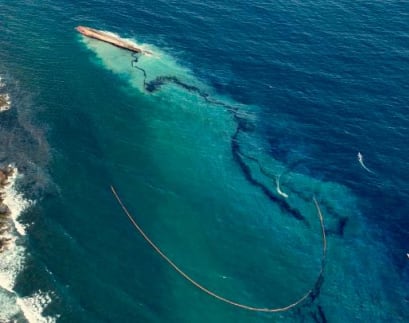
When these challenges are not addressed quickly, response activity can be delayed when speed and coordination are most needed. The 2002 Prestige incident off the coast of Galicia, Spain, demonstrates how complex decision-making across authorities can influence response outcomes, with consequences for coastlines across Spain, France and Portugal.
Clear authority, agreed escalation routes and established communication pathways can help reduce delays when agencies, regulators and operational teams need to act together. OSRL’s MT Evoikos case study demonstrates how structured response methodology can support decision-making and coordination in a complex operational context.
Navigating different regulatory frameworks
Rapid mobilisation can become more difficult when different national laws, approval mechanisms, reporting thresholds and environmental regulations need to be considered at the same time. Friction can arise while government and regulatory parties align response actions during an active incident.
An appropriate incident command structure provides a clearer framework for decision-making, escalation and regulatory engagement when response must move quickly while remaining compliant.
Aligning stakeholders and authorities
Aligning stakeholders and authorities can be challenging when priorities, mandates and operating models differ. Government agencies, port authorities, regulators, contractors and private operators may each have distinct statutory responsibilities, which can overlap or conflict.
In one country, authority may sit with a coastguard or maritime authority; in another, a navy, environmental regulator, port authority or national response agency may lead. In some regions, response may also be shaped by limitations in locally available equipment, technical resources or specialist personnel.
Early coordination helps ensure available capability is understood, mobilisation routes are clear and additional support can be integrated quickly.
Maintaining decision-making speed
Pre-established coordination structures and trusted communication pathways help maintain momentum during a crisis. In cross-jurisdictional incidents, decision-making speed can be constrained by the need to align authorities, meet compliance requirements and consult stakeholders before action can be taken.
When a structured approach to crisis preparedness and response is in place, organisations are better positioned to make informed decisions, escalate approvals and act without unnecessary delay.
Integrated response across multiple environments
Oil spill incidents rarely remain confined to one environment. A single incident can affect offshore, subsea, shoreline and ecological systems as conditions evolve. Each phase introduces technical, environmental and logistical challenges, often requiring input from multiple agencies, specialists and authorities.
A strategic, integrated response helps maintain continuity of capability as an incident transitions between environments, enabling teams, equipment and expertise to move across operational boundaries while maintaining coordination.
Offshore operations
Offshore operations present specific complexities, from distance from shore and weather conditions to asset deployment, mobilisation logistics and containment challenges. These factors require strategic preparedness to support an effective response.
OSRL’s offshore seminar explores priorities for offshore activities, including planning, media response and subsea oil spill preparedness.
Subsea incidents
Subsea incidents create technical challenges that differ from surface spills. They require specialist capability to detect, assess and contain releases at depth, as well as coordinated access to technical resources and expertise.
Spill detection, damage assessment and containment planning often involve multiple stakeholders, making prompt, informed decision-making essential. Through OSRL’s core membership coverage, organisations can access specialist oil spill response expertise and support.
Shoreline and coastal response
As incidents move from offshore waters towards shoreline and coastal environments, response operations become more complex due to environmental sensitivity, public impact and the number of agencies involved.
Coastlines support important habitats, including breeding grounds and nesting areas for wildlife, as well as industries such as ports, fisheries and tourism. Shoreline response requires coordination between operational responders, local authorities, environmental specialists and affected stakeholders.
Delayed or poorly coordinated responses can increase ecological, social and economic risk. Oil can adhere to rocks and vegetation, where it may persist for longer than in open water. Access to experienced responders and established processes helps protect communities, industries and the environment.
Wildlife and environmental considerations
To reduce risk to the local environment and wildlife, specialist response from multiple agencies may be required. Environmental and wildlife protection introduces additional operational layers, including sensitivity mapping, protection of vulnerable wildlife, minimising disturbance and understanding habitat-specific needs.
These considerations should be built into response planning from the outset, so environmental and wildlife priorities are considered alongside operational activity.
Why incident command structures matter
A clear Incident Command System, or similar incident management structure, is essential for establishing a cohesive chain of command during an oil spill incident. It supports coordination between government agencies, private organisations, responders and local authorities.
Establishing this structure from the beginning creates clear lines of communication and command, reducing uncertainty as agencies, authorities and responders begin working together.
Incident command structures provide defined roles, reporting lines and clarity around responsibilities, helping teams coordinate decisions, resources and actions more effectively.
The role of incident command systems
Incident Command Systems, or ICS-style structures, establish defined roles, responsibilities and reporting lines. They help teams understand who is responsible for key decisions, how information should flow and how actions should be coordinated.
Operators and authorities may use different incident management systems. Some may work to an Incident Command System, while others may use an Incident Management System aligned with local emergency arrangements, regulatory expectations or internal procedures. Early alignment helps reduce duplication and support coordinated decision-making.
Unified command and governance
A unified approach to command and governance allows organisations and agencies to share decision-making authority while maintaining operational alignment. This keeps communication clear, priorities understood and responsibilities visible during response operations.
Reducing operational friction during emergencies
Systems such as ICS or IMS can help reduce confusion, duplication and delay. Clear command structures ensure everyone understands their role, reporting line and decision-making responsibilities.
By supporting unified command, clear spans of control and resource tracking, these structures help organisations work towards a shared response strategy.
Preparedness is the foundation of coordination
Organisations with strong preparedness frameworks are better placed to respond cohesively under pressure. Strategic planning, technical expertise and pre-agreed systems help ensure personnel understand their roles, responsibilities and decision-making routes before an incident occurs.
An up-to-date contingency plan is also essential. When it has been exercised, teams can test communication pathways, validate response processes and act with greater confidence during a real incident.
Pre-positioned equipment is important for a prompt response. OSRL members have priority access to global response equipment stockpiles, supported by technical expertise and operational knowledge. Organisations can also hire oil spill response equipment from OSRL, supported by commissioning, maintenance and operator training.
-
Oil spill response training, simulations and drills help organisations identify gaps in communication, situational awareness, operational alignment, equipment deployment and command coordination.
OSRL’s technical teams provide training across scheduled courses and custom training solutions. OSRL training is accredited by the Nautical Institute and gives personnel the opportunity to apply procedures in practice, attend stakeholder workshops and take part in hands-on equipment deployment.
Multi-agency exercises help ensure everyone involved understands their role, responsibilities and place within the wider response structure before a real incident occurs.
-
Scenario planning enables organisations to anticipate how incidents may evolve across jurisdictions, environments and stakeholder groups, helping them identify challenges, resource requirements and response pathways.
For example, OSRL’s national workshop in Congo for Eni brought together operators, national oil companies, regulators and other key stakeholders to analyse realistic scenarios, review available resources and identify actions to strengthen response readiness.
Practising communication and collaboration in a non-emergency setting helps personnel strengthen capability for real-life events and supports a more coordinated response.
-
Building organisational readiness enables rapid, coordinated action if an incident occurs. Proactive preparedness ensures roles, resources and communication pathways are clearly defined, so teams can respond promptly, minimise environmental and economic impacts, and maintain safety.
Readiness also means embedding response systems, training and a culture of preparedness so teams understand what to do and how to work together under pressure.
The value of integrated support during complex incidents
Integrated support brings together expertise, systems and coordination frameworks to manage complex oil spill incidents. By aligning command structures, operational coordination and preparedness activities, organisations can create a unified approach that supports clear decision-making, efficient resource mobilisation and consistent execution.
When multiple jurisdictions, environments and pressures converge, integrated support helps reduce fragmentation and maintain momentum.
OSRL helps members manage complex incidents across borders, environments and authorities through integrated readiness, response capability and coordination across jurisdictions, assets and stakeholders. This helps reduce friction, speed up decision-making and improve response outcomes.